

Written by
Vadim Kotin
Published on
Sep 01, 2026
Read time
10 minute read
Google is making a major change to the way Local Services Ads (LSAs) are managed.
For local service businesses such as roofers, landscapers, plumbers, electricians, HVAC companies, pest control companies, movers, and cleaning companies, this is an important change to understand.
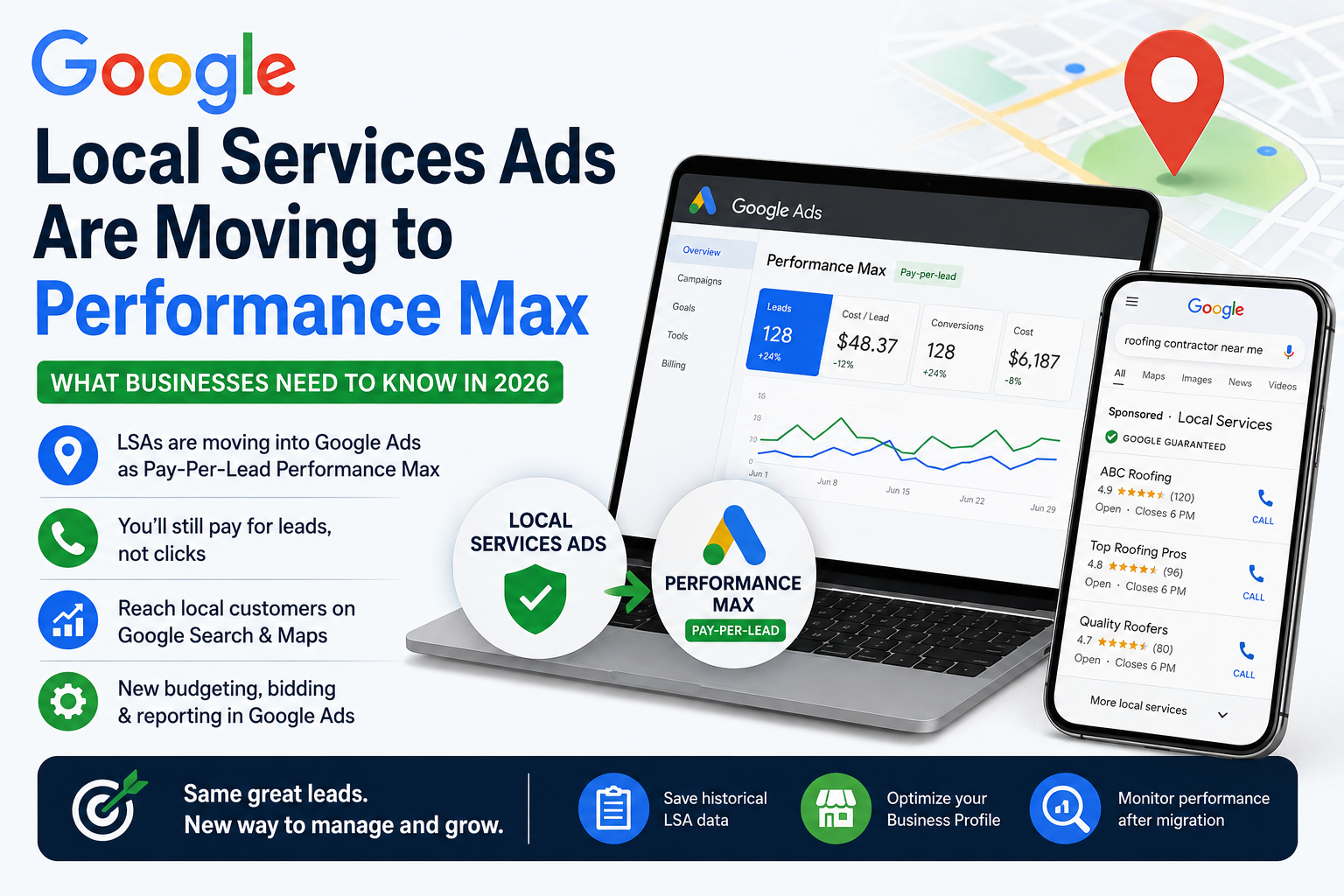
The good news is that the basic LSA advertising model is not disappearing. Businesses will still be able to generate leads from Google Search and Google Maps and pay for leads rather than ordinary clicks.
What is changing is where campaigns are managed, how budgets and bidding work, and how advertisers interact with their campaigns.
What Is Changing With Google Local Services Ads?
For years, Local Services Ads have operated separately from traditional Google Ads.
Businesses typically managed their LSAs through the dedicated Local Services Ads platform, while their regular Search, Display, YouTube, and Performance Max campaigns were managed inside Google Ads.
Google is now bringing these systems closer together.
Existing Local Services campaigns will be migrated into Google Ads as Performance Max campaigns using a pay-per-lead goal. The separate LSA management experience is being phased out as the migration progresses.
This means local businesses will increasingly have one Google advertising environment for managing their campaigns and leads.
The important distinction: this is not ordinary Performance Max
The word “Performance Max” can be confusing because traditional PMax campaigns can serve across Google’s broader advertising ecosystem.
The new pay-per-lead version used for Local Services Ads is different.
These campaigns will continue to focus on Google Search and Google Maps, rather than automatically expanding across YouTube, Gmail, Display, and other Google properties like standard PMax campaigns.
The campaigns also remain keywordless. Instead of building a traditional keyword list, Google uses information about your business, services, categories, and service areas to determine when your local ad should appear.
What Will Stay the Same?
Despite the platform change, several important parts of Local Services Ads will remain familiar.
1. You will still pay for leads
The biggest advantage of LSAs remains intact.
Instead of paying for every click, eligible advertisers continue to use a pay-per-lead model. Depending on the setup, leads can include customer calls, messages, or other qualifying contact actions.
That makes LSAs particularly attractive for local service companies where a phone call or quote request can be worth significantly more than a website visit.
2. Ads will continue appearing on Google Search and Maps
The migration does not mean your Local Services Ads suddenly become traditional PMax ads.
Google says pay-per-lead campaigns will continue serving on eligible Search and Maps placements.
This is important because LSAs can appear prominently when someone is actively looking for a local service.
For example:
- “roofers near me”
- “emergency plumber”
- “landscaping company Vancouver”
- “pest control near me”
- “HVAC repair”
- “electrician in Surrey”
The exact visibility and eligibility depend on Google’s systems, business category, location, and account settings.
3. Keyword management is still not required
Traditional Google Search campaigns rely heavily on keywords.
LSAs work differently.
With pay-per-lead campaigns, advertisers don’t build and maintain a conventional keyword list. Google uses business information, service categories, locations, and other signals to match local customers with eligible providers.
This can make LSAs easier to launch, but it also means advertisers have less direct control over individual search queries than they would with a traditional Search campaign.
4. Your Google Business Profile becomes even more important
Your Google Business Profile is a critical component of your local advertising strategy.
As LSAs move into Google Ads, information associated with your Business Profile becomes increasingly important to the advertising setup.
That means businesses should make sure their profile contains accurate:
- Business information
- Service categories
- Service areas
- Business hours
- Photos
- Services
- Contact information
- Reviews
A poorly maintained Business Profile can create problems for a local advertising campaign even if the advertising account itself is configured correctly.
What Is Changing?
The transition introduces several important differences that advertisers should understand.
Local Services Ads are moving into Google Ads
The biggest change is the management platform.
Instead of switching between a separate Local Services dashboard and Google Ads, businesses will increasingly manage their LSA campaigns through Google Ads.
Google says the standalone LSA dashboard is being phased out as the migration progresses, with the overall transition scheduled to extend through 2027.
For agencies managing multiple advertising channels, this could simplify account management considerably.
Weekly Budgets Are Becoming Daily Budgets
Another significant change involves budgeting.
Traditional LSAs have historically used weekly budget settings.
Google Ads uses daily budgets and monthly spending limits.
When an LSA campaign migrates, Google converts the historical weekly budget into a corresponding daily budget. Google says the monthly spending limit is based on the daily average multiplied by approximately 30.4.
For example, if your historical weekly budget was $700, the system could convert that to approximately:
$700 ÷ 7 = $100/day
The exact account configuration should always be reviewed after migration.
This is important because advertisers who are accustomed to thinking about LSA spending on a weekly basis will now need to monitor budgets using the Google Ads framework.
Manual Bidding Is Going Away
Another major change is bidding.
Google is discontinuing manual bidding options that were available under the previous Local Services Ads system.
Advertisers moving into Google Ads will instead use Google’s automated bidding framework for these pay-per-lead campaigns. Vertical-level Target CPA settings are also being replaced by campaign-level bidding configurations.
This is consistent with Google’s broader move toward automated bidding and machine-learning-driven campaign management.
For advertisers, however, it makes conversion and lead-quality data even more important.
If Google is responsible for deciding which opportunities to pursue, you want to make sure the system is receiving accurate signals about what constitutes a valuable lead.
Historical LSA Reporting Needs Attention
This is one of the most important things advertisers should do before their account migrates.
Your historical LSA campaign reports will not automatically transfer into Google Ads in the same way your active campaign information does.
Google specifically recommends saving historical performance reports before migration.
That data may be useful later for:
- Comparing lead costs
- Measuring year-over-year performance
- Evaluating seasonal trends
- Reviewing lead volume
- Calculating return on advertising spend
- Comparing performance before and after migration
If you have years of LSA data, don’t assume it will remain available in the new interface.
Export or save your historical reports before your account migrates.
What Happens to Existing LSA Campaigns?
For businesses already running Local Services Ads, Google is handling the migration automatically.
Google’s rollout is happening in stages rather than moving every advertiser at the same time.
The first phase began in August 2026 for selected U.S. home and storefront service businesses, including categories such as roofing, plumbing, HVAC, electrical, pest control, lawn care, house cleaning, appliance repair, and moving.
Additional groups are expected to transition later in 2026, while non-U.S. accounts and remaining categories are scheduled to transition during 2027.
Advertisers should receive advance notification before their account is migrated.
What Should Businesses Do Before Migration?
Even though Google is handling the migration, there are several things businesses should do proactively.
1. Save your historical LSA data
This should be your first priority.
Export the reports you may want to reference later.
At minimum, save information about:
- Lead volume
- Cost
- Lead types
- Calls
- Messages
- Booking activity
- Campaign performance
- Budget
- Lead cost
This gives you a benchmark for measuring performance after the migration.
2. Review your Google Business Profile
Make sure your Business Profile accurately represents the business.
Check your:
- Primary category
- Services
- Service areas
- Phone number
- Website
- Business hours
- Photos
- Business description
- Reviews
Local advertising and local SEO are becoming increasingly interconnected, so your Business Profile should be treated as an important marketing asset rather than simply a listing.
3. Review your current LSA settings
Before migration, check whether your current:
- Service categories
- Locations
- Business information
- Photos
- Ad schedule
- Budget
- Lead settings
are still correct.
If something is wrong now, migrating the campaign won’t necessarily solve the underlying problem.
4. Don’t make major changes immediately after migration
Google recommends allowing time for the migrated campaign to stabilize.
Google notes that although campaigns may begin serving quickly after migration, the transition and performance stabilization can take up to approximately two weeks.
For that reason, avoid making a large number of changes immediately after migration unless there is a clear problem that needs to be corrected.
Establish a baseline first.
Then optimize based on actual performance.
How Will This Affect Local Service Businesses?
For most businesses, the change is more about campaign management than the fundamental way LSAs generate customers.
A roofing company, for example, will still want to appear when homeowners are searching for roofing services in its market.
A landscaping company will still want to generate calls and quote requests from people looking for landscaping services.
A plumbing company will still want to capture high-intent local searches.
The difference is that these campaigns are becoming part of a larger Google Ads ecosystem.
This could make it easier for businesses and agencies to manage multiple advertising channels from one account.
It also means advertisers need to become more comfortable with Google’s automated systems.
LSA vs. Traditional Google Search Ads
One of the biggest mistakes businesses can make is assuming that the new PMax-based LSAs replace traditional Search campaigns.
They don’t.
They serve different purposes.
Local Services Ads
LSAs are designed around:
- Local customers
- Service businesses
- Google Search and Maps
- Pay-per-lead advertising
- Business Profile information
- Automated, keywordless targeting
Traditional Google Search Ads
Search campaigns provide more direct control over:
- Long Tail Keywords
- Match types
- Negative keywords
- Search terms
- Ad messaging
- Landing pages
- Geographic targeting
- Audience targeting
- Bidding strategies
For many local businesses, the strongest Google advertising strategy may involve using both.
LSAs can capture highly qualified local leads, while traditional Search campaigns can provide additional control and reach.
Why Lead Quality Will Matter More Than Ever
One potential challenge with increasing automation is that generating more leads isn’t necessarily the same as generating more customers.
A campaign can produce a large number of leads while still performing poorly if those leads are:
- Outside the service area
- Looking for a service you don’t offer
- Price shoppers
- Spam
- Duplicate inquiries
- Unqualified prospects
For service businesses, the ultimate goal should not simply be more leads.
It should be more qualified leads that turn into profitable customers.
That means businesses should track what happens after a lead is generated.
For example:
Lead → Qualified Lead → Estimate → Sale → Revenue
This is much more useful than simply looking at the number of LSA leads.
What This Means for Google Ads Management
The migration reinforces a larger trend in Google Ads: Google is taking more responsibility for targeting, bidding, and campaign optimization.
That doesn’t mean advertisers can simply turn campaigns on and forget about them.
In fact, strategy becomes even more important.
Advertisers should focus on:
- Accurate conversion tracking
- Strong Google Business Profile optimization
- High-quality service information
- Accurate location targeting
- Lead-quality monitoring
- Budget management
- Customer acquisition costs
- Sales tracking
- Landing-page performance
- Overall account structure
Automation can make decisions faster, but it still needs good business data.
Google’s Local Services Ads transition is a significant change, but it doesn’t mean the LSA advertising model is going away.
Instead, Google is moving LSAs into the Google Ads environment through specialized Performance Max campaigns with pay-per-lead goals.
The core benefits remain:
- Pay for leads rather than ordinary clicks
- Appear on Google Search and Maps
- Reach customers looking for local services
- Use service categories and geographic targeting
- Connect customers directly with your business
The biggest changes involve campaign management, budgeting, bidding, reporting, and the integration with Google Ads.
For businesses already using LSAs, the most important steps are simple:
Save your historical data. Review your Google Business Profile. Check your campaign settings. Watch for Google’s migration notification. Then monitor the new campaign carefully after the transition.
For local service businesses that are not currently using LSAs, 2026–2027 may be a good time to evaluate how Local Services Ads fit into a broader Google Ads and local SEO strategy.
The companies that benefit most won’t necessarily be the ones generating the most leads. They’ll be the ones that combine Google’s automation with accurate tracking, strong local visibility, and a focus on generating qualified leads that actually become customers.
Need Help Managing Google Ads and Local Services Ads?
Google is changing how Local Services Ads work, and managing local advertising is becoming more complex. If you’re already running LSAs or Google Ads – or you’re considering using them to generate more leads – having the right strategy can make a significant difference.
At Kotin Digital, we help local service businesses build and manage Google Ads campaigns focused on generating qualified leads, phone calls, and new customers – not just clicks.
Our Google Ads management services can help you:
- Set up and optimize Google Search and Performance Max campaigns
- Manage Local Services Ads and the transition to the new Google Ads system
- Reduce wasted ad spend and improve cost per lead
- Track phone calls, form submissions, and qualified leads
- Optimize campaigns based on lead quality and actual business results
- Identify opportunities to increase leads without unnecessarily increasing your advertising budget
Don’t leave your Google Ads budget on autopilot.
If you’re looking for a Google Ads management company that understands local lead generation, contact Kotin Digital for a free consultation and let’s see where your campaigns can be improved.