
Written by
Vadim Kotin
Published on
Jul 28, 2026
Read time
5 minute read
If your Google Ads campaigns are generating plenty of clicks but few leads, your keywords may be the problem. Many businesses make the mistake of targeting broad, highly competitive search terms that attract a wide audience but fail to reach people who are ready to buy.
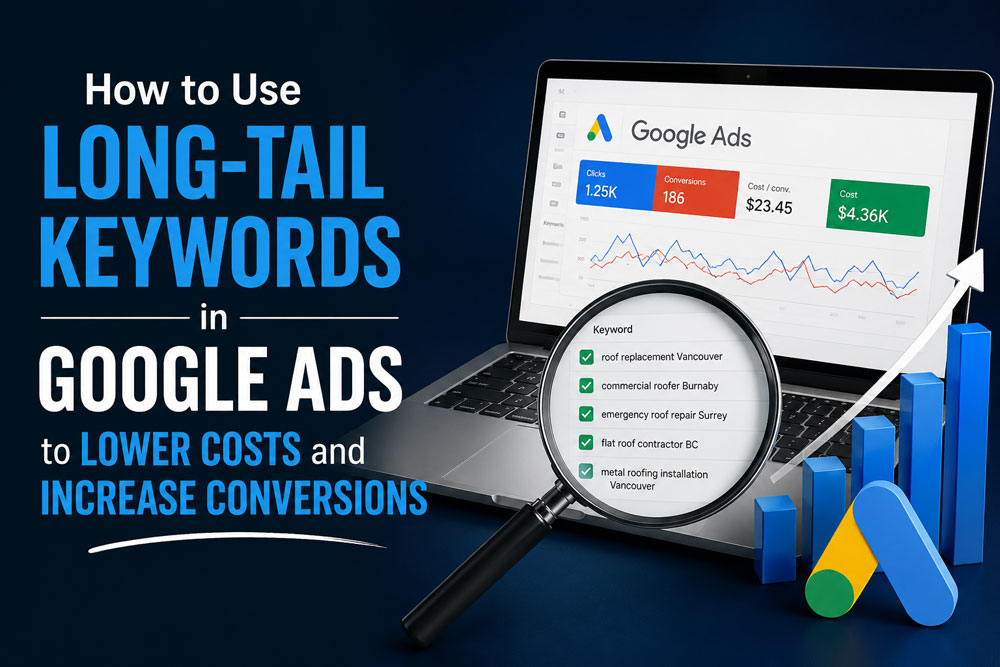
A smarter approach is to focus on long-tail keywords – more specific search phrases that reveal clear intent. While these keywords typically have lower search volume, they often deliver higher conversion rates, lower cost per click (CPC), and a better return on investment.
In this guide, we’ll explain what long-tail keywords are, why they matter, and how to use them to improve your Google Ads performance.
What Are Long-Tail Keywords?
Long-tail keywords are longer, more detailed search phrases that typically contain three or more words. Instead of targeting a broad keyword like:
- roofing company
You might target:
- commercial roofing company in Vancouver
- emergency roof repair Burnaby
- flat roof replacement contractor Surrey
These searches may receive fewer monthly searches, but they often come from people who know exactly what they need.
Someone searching for “roofing company” could simply be researching.
Someone searching for “commercial roofing contractor near me with free estimate” is much closer to making a decision.
Why Long-Tail Keywords Perform Better
One of the biggest advantages of long-tail keywords is search intent.
The more specific a search becomes, the more likely the user is looking to take action.
Benefits include:
- Higher conversion rates
- Lower cost per click
- Less competition
- Better Quality Scores
- More qualified leads
- Improved return on ad spend (ROAS)
Rather than competing against hundreds of advertisers for a broad keyword, you’re focusing on searches that better match your services.
Broad Keywords vs. Long-Tail Keywords
| Broad Keyword | Long-Tail Keyword |
|---|---|
| plumber | emergency plumber Vancouver 24 hours |
| dentist | Invisalign dentist Burnaby |
| landscaper | backyard landscaping contractor Richmond BC |
| accountant | small business accountant Vancouver |
| PPC agency | Google Ads management for contractors Vancouver |
Broad keywords generate traffic.
Long-tail keywords generate customers.
Why They Usually Cost Less
Google Ads is an auction.
Highly competitive keywords attract more advertisers, driving CPCs higher.
For example:
- “lawyer” may cost dozens of dollars per click.
- “commercial real estate lawyer Vancouver” may cost less while attracting a much more qualified audience.
Since fewer advertisers target highly specific phrases, competition is often lower, helping you stretch your advertising budget further.
Long-Tail Keywords Match Buying Intent
People move through different stages before making a purchase.
Research Stage
Examples:
- What is Google Ads?
- How does PPC work?
- SEO vs Google Ads
These users are gathering information.
Comparison Stage
Examples:
- best PPC agency Vancouver
- Google Ads management pricing
- local PPC agency reviews
These users are evaluating their options.
Purchase Stage
Examples:
- hire Google Ads agency Vancouver
- Google Ads management company near me
- PPC consultant for roofing company
These searches often indicate someone is ready to contact a business.
How to Find Long-Tail Keywords
1. Use Google Keyword Planner
Google Keyword Planner is a great starting point for discovering keyword ideas.
Enter one of your services and review related searches.
Look for:
- location-specific searches
- service variations
- problem-based searches
- industry-specific phrases
2. Review Your Search Terms Report
One of the best sources of keyword ideas is your own Google Ads account.
The Search Terms Report shows the exact searches people used before clicking your ad.
You may discover valuable phrases that deserve their own ad groups or campaigns.
For example:
Instead of targeting:
roofing company
You might find:
- cedar roof replacement Vancouver
- torch-on roofing contractor
- roof leak repair Richmond
3. Use Google’s Autocomplete
Begin typing your service into Google.
Google’s autocomplete suggestions often reveal common searches made by real users.
You can also review the “People Also Ask” section and related searches at the bottom of the results page for additional ideas.
4. Listen to Your Customers
Your customers often describe their problems differently than marketers.
Pay attention to:
- phone calls
- contact form submissions
- sales conversations
- customer reviews
These can reveal the exact language your audience uses when searching online.
Organize Keywords by Theme
Instead of placing dozens of unrelated keywords into one ad group, organize them by service.
Example for a roofing company:
Roof Repair
- emergency roof repair
- roof leak repair
- roof repair near me
Roof Replacement
- roof replacement contractor
- asphalt roof replacement
- residential roof replacement
Commercial Roofing
- commercial roofing company
- flat roof contractor
- industrial roofing services
Creating tightly themed ad groups helps you write more relevant ads and improve Quality Score.
Match Your Landing Page to the Keyword
Even the best keyword won’t perform well if visitors land on the wrong page.
For example:
Someone searching for:
commercial roofing contractor Vancouver
should land on a page specifically about commercial roofing – not your homepage.
Relevant landing pages typically produce:
- higher conversion rates
- lower bounce rates
- better Quality Scores
- lower CPCs
The closer the match between the keyword, ad, and landing page optimization, the stronger your campaign performance is likely to be.
Don’t Forget Negative Keywords
Negative keywords prevent your ads from appearing for irrelevant searches.
Examples include:
- free
- jobs
- careers
- DIY
- training
- salary
If you’re a PPC agency, you probably don’t want your ads appearing for searches like:
- Google Ads jobs
- free PPC course
- how to become a PPC specialist
Regularly reviewing your search terms and adding negative keywords can help reduce wasted ad spend.
Measure Performance Beyond Clicks
High click-through rates are encouraging, but conversions matter more.
Track metrics such as:
- Cost per lead
- Conversion rate
- Return on ad spend (ROAS)
- Cost per acquisition (CPA)
- Phone calls
- Form submissions
- Qualified leads
Optimizing for business outcomes – not just traffic – helps ensure your campaigns deliver real value.
Common Mistakes to Avoid
Many advertisers limit their results by making avoidable mistakes.
Watch out for:
- Targeting only high-volume keywords
- Ignoring search intent
- Sending all traffic to the homepage
- Mixing unrelated keywords in the same ad group
- Failing to add negative keywords
- Not reviewing search terms regularly
- Measuring clicks instead of conversions
Small improvements in these areas can significantly improve campaign performance over time.
Long-tail keywords may not generate the highest traffic numbers, but they often attract the visitors who are most likely to become customers.
By focusing on specific, high-intent searches, organizing campaigns effectively, and directing users to relevant landing pages, you can improve lead quality while reducing wasted ad spend.
If your current Google Ads campaign isn’t generating leads, refining your keyword strategy is one of the most effective places to start.
At Kotin Digital, we help businesses build data-driven Google Ads campaigns that attract qualified leads, reduce acquisition costs, and maximize return on investment. Whether you’re launching a new campaign or improving an existing one, our team can help you develop a keyword strategy that supports long-term growth.
Ready to improve your Google Ads performance?
Contact Kotin Digital today for a free PPC consultation and discover how a smarter keyword strategy can generate more qualified leads for your business.