

Written by
Vadim Kotin
Published on
Sep 08, 2026
Read time
10 minute read
Search has changed more in the last three years than in the previous decade. Google now answers many questions directly on the results page, AI chatbots pull information straight from websites to answer users without a single click, and ranking algorithms lean harder than ever on machine learning to judge what “good” content actually looks like. Sitting at the center of all this is a discipline marketers now call AI SEO.
If you’ve heard the term thrown around and want a straight answer to what it means, whether you need it, and how to actually use it, this guide covers all of that — including when it makes sense to bring in AI SEO services rather than handle it yourself.
What Is AI SEO?
AI SEO is the practice of using artificial intelligence — machine learning models, natural language processing, and generative AI tools — to plan, create, and refine the work that makes a website visible in search. It touches nearly every part of the SEO process: finding what people are searching for, writing and structuring content, fixing technical site issues, and measuring what’s actually working.
The easiest way to think about it: traditional SEO is something you do to a search engine. AI SEO is something you do with AI, using its pattern-recognition and language capabilities to work faster, spot things humans would miss, and keep pace with search engines that are themselves powered by AI.
It’s also worth separating AI SEO into two related ideas people often blend together:
- Using AI to do SEO better — research, drafting, auditing, and reporting, sped up by AI tools.
- Optimizing to be visible in AI-generated answers — showing up in tools like ChatGPT, Google’s AI Overviews, or Perplexity, sometimes called generative engine optimization (GEO).
A complete AI SEO strategy usually covers both.
Why AI SEO Matters Now
Search engines aren’t matching keywords anymore — they’re interpreting meaning. A modern ranking system reads a page roughly the way a person would, weighing context, relevance, and trustworthiness rather than counting how many times a phrase appears. That shift alone would justify a smarter approach to optimization.
But there’s a second, bigger reason: a growing share of searches never produce a click at all. The person asks a question, gets an answer summarized on the page or inside a chatbot, and moves on. If your content isn’t structured in a way that AI systems can understand, extract, and trust, you’re invisible in exactly the moments where buying decisions are forming.
For a business, this changes the scoreboard. Traffic is still important, but so is a newer question: does AI know who we are, and does it trust us enough to mention us?
How AI SEO Differs From Traditional SEO
| Traditional SEO | AI SEO |
|---|---|
| Built around keywords and density | Built around topics, entities, and intent |
| Manual research and reporting | Automated pattern detection at scale |
| Reacts to ranking changes after the fact | Flags shifts and opportunities in near real time |
| Optimizes only for search engine results pages | Optimizes for search results and AI-generated answers |
| One-size-fits-all content plans | Personalized, intent-matched content recommendations |
None of this means old-fashioned SEO fundamentals — good content, solid site structure, real authority — have stopped mattering. AI SEO builds on top of them; it doesn’t replace them.
The Core Pieces of AI SEO Optimization
Good AI SEO optimization isn’t a single tool or trick — it’s a handful of workflows layered together.
1. Smarter keyword and topic research
AI models can scan enormous volumes of search data and group queries by what the searcher actually wants, not just by shared words. This surfaces topic clusters and question patterns a manual spreadsheet-based process would take weeks to find.
2. Content built for both readers and machines
AI tools help draft outlines, tighten structure, and check whether a page fully covers a topic compared to what’s already ranking. The best use of AI here is as a co-writer and editor — a way to move faster and catch gaps — not a replacement for a human voice and real expertise.
3. Technical health monitoring
Crawl errors, slow pages, broken schema, and indexing problems are exactly the kind of issue machine learning is good at catching early. AI-driven auditing tools can flag anomalies in site behavior before they turn into a ranking drop.
4. Structured data and entity clarity
Search engines and AI assistants rely heavily on structured data (schema markup) to understand what a page is actually about — a recipe, a service, a product, a review. Clear entity signals make it far easier for AI systems to summarize your content accurately, and to credit you when they do.
5. Visibility inside AI-generated answers
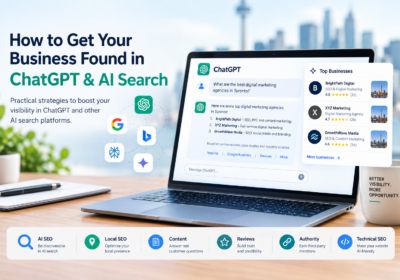
This is the newer frontier: making sure that when someone asks a chatbot or an AI Overview a question your business can answer, your content is the one it pulls from. That means clear, direct answers near the top of a section, credible sourcing, and content that says something genuinely useful rather than repeating what’s already everywhere else online.
6. Continuous performance tracking
Instead of a monthly report, AI-powered analytics can flag a sudden ranking swing, a competitor’s move, or an algorithm update within hours — giving you time to react instead of finding out a quarter late.
AI SEO for Small Business: Does It Actually Apply to You?
It’s easy to assume AI SEO is an enterprise-only concern, reserved for sites with thousands of pages and dedicated marketing teams. In practice, AI SEO for small business is often where it delivers the most relative value, for a simple reason: small teams have the least time to spare on manual busywork.
A few ways it shows up practically for a smaller operation:
- Leveling the playing field on research. A solo marketer or small team can use AI tools to do keyword and competitor research that used to require a full analyst.
- Faster content production without losing quality control. AI drafts and outlines cut down the blank-page problem, freeing up the owner or in-house writer to focus on the parts only a human can do — real experience, opinions, and local knowledge.
- Catching technical problems before they cost you customers. A broken page or a slow-loading site hurts a local bakery or a boutique law firm just as much as a Fortune 500 company — arguably more, since there’s less brand recognition to fall back on.
- Being findable in AI answers, not just Google’s blue links. When someone asks an AI assistant “who does the best kitchen remodels near me” or “what’s a good CRM for a five-person team,” small businesses with clear, well-structured content have a real shot at being the answer — sometimes ahead of bigger competitors with bloated, generic pages.
The barrier to entry for AI SEO tools has also dropped substantially. Many of the AI-assisted platforms for keyword research, content optimization, and site auditing now offer plans built for small budgets, not just large agencies.
When to Consider AI SEO Services
Doing some of this yourself is realistic, especially with the growing number of accessible AI tools. But there’s a point where bringing in dedicated AI SEO services — an agency or consultant who specializes in this — makes sense:
- You don’t have the internal time to keep up with tool changes, algorithm updates, and testing.
- You’ve tried AI-generated content and it isn’t ranking, which usually means it lacks the editing, structure, and expertise signals search engines and AI systems are looking for.
- You’re overwhelmed by conflicting advice and want a strategy tailored to your specific industry and competitors, not generic best practices.
- You want someone actively tracking your visibility inside AI Overviews and chatbot answers, not just traditional rankings.
A good AI SEO service should be able to explain, in plain language, what tools they use, what a human actually reviews versus what’s automated, and how they measure success beyond just “more traffic.” If an agency can’t answer those questions clearly, that’s a red flag.
Getting Started With AI SEO: A Simple First Step
You don’t need to overhaul everything at once. A sensible starting point:
- Audit your best-performing page. Look at what’s already working and ask an AI tool to compare it against top-ranking competitors — what’s missing, what could be clearer, where the structure could improve.
- Add clear, direct answers near the top of key pages. If someone — or an AI system — is scanning for a quick answer, make sure it’s easy to find and lift.
- Clean up structured data. Even basic schema markup (business info, FAQs, products) makes a real difference in how confidently AI systems can describe what you offer.
- Pick one AI tool and learn it well rather than juggling five half-used ones.
AI SEO isn’t a replacement for good marketing fundamentals — it’s a faster, sharper way to do them, and increasingly a requirement for staying visible as search itself becomes AI-driven. Whether you handle it in-house with the growing set of accessible tools, or bring in dedicated AI SEO services to manage it for you, the businesses that adapt now — including small businesses with far more agility than they realize — will be the ones AI systems recommend later.
FAQ
Is AI SEO different from regular SEO? Not entirely separate — it’s an evolution. AI SEO uses artificial intelligence to do traditional SEO tasks (research, content, technical audits) faster and more precisely, while also targeting visibility inside AI-generated answers, which regular SEO historically didn’t have to consider.
Can a small business do AI SEO without hiring an agency? Yes, to a meaningful extent. Many AI SEO tools are built for small budgets and non-specialists. An agency becomes worth it when you need strategy, ongoing monitoring, or don’t have the time to manage it yourself.
Does AI-written content rank well on its own? Rarely, without human editing. Search engines and AI systems increasingly favor content with real expertise, original insight, and a clear human voice — AI is best used to speed up drafting and research, not to publish unedited output.
Ready to Make AI Work for Your Search Visibility?
Not sure where to start with AI SEO? You don’t have to figure it out alone. Book a free AI SEO audit and we’ll show you exactly where your site stands today — and what it would take to get you showing up in both search results and AI-generated answers.